
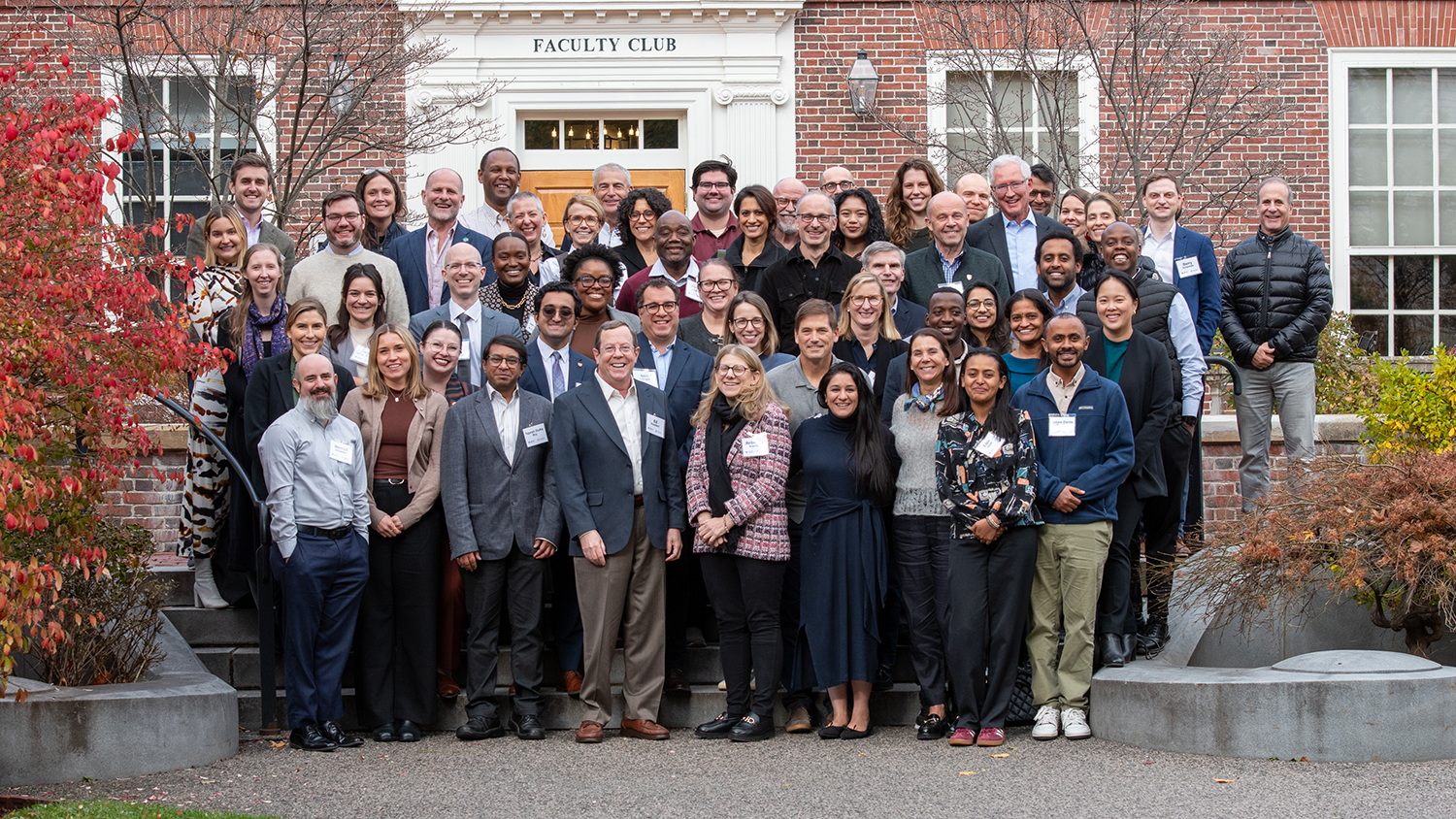
Summit participants gathered on the steps of the Harvard Faculty Club.
Over 75 leaders from global health, technology, finance, philanthropy, and policy convened at the Harvard Faculty Club in Cambridge, MA, on November 19–20, 2025, for a two-day summit focused on expanding equitable access to clinical artificial intelligence (AI) in low- and middle-income countries (LMICs). The Summit on Clinical AI for Global Health aimed to identify concrete pathways to make scalable, high-impact AI solutions available where health needs are greatest.
The Summit emerged directly from an earlier Harvard Radcliffe Institute Accelerator Workshop that the Harvard Medical School Center for Bioethics hosted on ethical issues in AI—particularly privacy, data ownership, accuracy, and bias, which are often cited as reasons to slow clinical AI development. While participants took these concerns seriously, they concluded that the most urgent ethical challenge is our failure to harness the potential of existing clinical AI tools to save millions of lives in LMICs right now. In response, the Summit was created as a launchpad: a venue for forging collaborations, generating new ideas, and defining actionable strategies that institutions can begin implementing immediately.
The summit opened on Wednesday, November 19, with welcomes from Ed Hundert, MD and Rebecca Brendel, MD, JD of Harvard Medical School Center for Bioethics. In the opening spark talk, Claire Wagner, MD, MBA of Avenir Management Partners shared lessons from the pharmaceutical sector on how regulation, markets, and corporate strategy can be mobilized to advance global health access, using advances in access to pharmaceuticals and vaccines in LMICs as a case study. The morning’s first major session centered on regulatory strategies, asking whether AI governance could be intentionally designed to encourage clinical AI tailored to LMIC contexts. A panel and large-group discussion explored how safety, effectiveness, and equity considerations might be balanced in regulatory frameworks that both protect patients and accelerate innovation for underserved settings. The panel included I. Glenn Cohen, JD of Harvard Law School, Gabriele Mazzini, LLM of MIT, Barry Solaiman, PhD of Hamad Bin Khalifa University (HBKU) Law, Qatar, and was moderated by Effy Vayena, PhD of the Swiss Federal Institute of Technology, Zürich—and former lecturer of the 2024 George W. Gay Lecture in Medical Ethics, where she discussed bioethics in the age of artificial intelligence.
The focus then shifted to market-shaping strategies, beginning with a spark talk by Ben Brockman of the Clinton Health Access Initiative (CHAI). He outlined some of the most promising impact opportunities for clinical AI and the implementation barriers that currently impede widespread use in LMICs. A late-morning panel moderated by Brockman examined how to overcome these obstacles—ranging from data infrastructure and workforce readiness to procurement, reimbursement, and integration into existing health systems. Panelists included Eulade Rugengamanzi, MMed of University of Global Health Equity (UGHE), Anne Stake, MPP of the Gates Foundation, Milind Tambe, PhD, MSc of Harvard University, and Rebecca Weintraub, MD of the Global Health Delivery Project. During the networking lunch which followed, as one example of Summit connections, Dr. Akwi Asombang, a recent graduate of the Master of Science in Bioethics, Associate Professor of Medicine at Harvard Medical School, and founder of The African Association of Future Gastroenterologists (AAFG), was particularly excited to meet with Dr. Eulade Rugengamanzi from the panel to discuss launching a new gastroenterology project with UGHE in Butaro, Rwanda.
Participants then turned to the role of capital. A spark talk by James Bair of Baraka Impact Finance and subsequent panel considered how innovative financing mechanisms—such as blended finance, outcome-based models, and pooled purchasing—could align investment with solutions that are scalable, sustainable, and equitably distributed. Panelists included Sarah Della Rippa, MSc of ArcHealth Foundation, Neel Lakhani of CHAI, and Dr. Claire Wagner. “Tightening health budgets across LMICs means every dollar needs to work harder,” said Lakhani, “AI-powered clinical decision support could deliver real efficiency gains and cost savings—but only if we build solutions for LMIC constraints from the start, not retrofit them years later. We already know how to accelerate introduction. Market shaping approaches have driven 80-90% price reductions for HIV treatment, scaling access 120-fold over two decades. Similar coordination accelerated malaria prevention and treatment rollouts and transformed family planning commodity markets. The same playbook applies to AI: coordinated action across regulators, manufacturers, funders, and implementers to compress adoption timelines.”
In the afternoon, four breakout groups were tasked with responding to specific challenges surfaced in the market-shaping discussions. Synthesis leads then presented key findings, including summarized points collected by Otter.AI, back to the full group, highlighting emerging priorities and actionable ideas. The day closed with a large-group session dedicated to commitments for continued work on market-shaping strategies.
Thursday, November 20, turned to health tech enterprise strategies and the role of technology firms in bridging health gaps with AI. The morning spark talk by Jayasree Iyer, PhD of the Access to Medicine Foundation, drew on pharmaceutical experience in LMICs, setting up a panel and discussion on how tech companies can responsibly design, deploy, and maintain AI tools that are affordable, context-appropriate, and responsive to local health priorities. Iyer joined Monica Bharel, MD, MPH of Google and Neerav Kingsland, JD of Mission Labs, Anthropic as panelists, with Dr. Claire Wagner as moderator. “In an era where AI is transformative and accelerating, we must stay anchored in practical and morally grounded innovation,” said Iyer, “In health, this means committing to need-driven approaches that lead to equitable clinical AI for tools that genuinely work for patients and communities, especially in underserved setting.” Breakout groups then developed responses to targeted questions on business models, partnerships, and accountability, before reconvening for synthesized presentations and a large-group dialogue on long-term corporate commitments.
The summit concluded with lunch, a group photo, and a final plenary session focused on next steps and concrete projects to pursue after the meeting. By the close of the final working session, participants had moved beyond high-level principles to a set of emerging projects and coalitions. While each is at a different stage of development, together they illustrate the kind of practical, multi‑stakeholder action the Summit aimed to launch.
Some of these projects include:
- Donating AI tools to clinicians in LMICs, along with professional trainings and tech demonstrations conducted by the developers
- Connecting AI engineers to global health projects, with special emphasis on engaging young software engineers entering the industry
- Expanding LLMs to other languages, like Kinyarwanda, for use in clinical AI applications
- Exploring LLM valuation to develop an AI model based on bioethical frameworks
- Financing innovators quickly and effectively
- Expanding the taxonomy of AI health tools to better ensure solutions are specific to cultural context
- Indexing devices and impact investors for accountability purposes
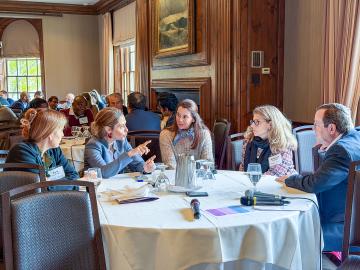
Across these emerging projects, a common pattern is clear: each requires coalitions that cut across traditional silos. Clinicians, developers, regulators, funders, ethicists, and local implementers need to work together. Many participants remarked in follow up reflections that what made the Summit so powerful was having representatives from organizations as diverse as the Gates Foundation, the University of Global Health Equity, the World Economic Forum, Kaiser Permanente, the World Bank, the Clinton Health Access Initiative, and leading academic medical centers all aligning around this shared mission. “The Summit on Clinical AI for Global Health was timely, thoughtfully curated, and highly relevant to current challenges in translating AI from research settings into real-world clinical impact,” said Dr. Fatima Mirza, a Fellow at Brown University, “The interdisciplinary nature of the speakers, spanning clinicians, technologists, policymakers, and global health leaders, was a particular strength and fostered meaningful cross-sector dialogue. Several aspects stood out positively, including the emphasis on implementation science, equity-aware model development, and the realities of deployment in resource-constrained settings.
This emphasis on cross sector collaboration echoes a core principle of Dr. Paul Farmer’s legacy at Harvard Medical School. As he put it,
“…all of your most important achievements on this planet will come from working with others – or, in a word, partnership.”
In the months ahead, Summit participants will convene in follow‑up virtual meetings to refine these ideas, bring in additional partners, and move from concept to implementation. Harvard Medical School will be spotlighting some of these projects in articles to come.
This Summit was made possible by the generous support of many individuals and organizations. We are deeply grateful to the following partners for their contributions:
- Harvard Medical School: Center for Bioethics; the department of Global Health & Social Medicine; Paul Farmer Collaborative; and the department of Biomedical Informatics
- Harvard Law School: Petrie-Flom Center for Health Law Policy, Biotechnology, and Bioethics
- Harvard T.H. Chan School of Public Health: Adriadne Labs; Global Health Delivery Project; and the Division of Global Health Equity at Brigham and Women’s Hospital
- Anthropic
- ARC Health
- Avenir Management Partners
- Baraka Impact Finance
- Centre for Addiction and Mental Health
- Clinton Health Access Initiative
- ETH Zürich Health Ethics & Policy Lab
- Evidence Action
- Hamad Bin Khalifa University
- NYU Langone Health
- Stanford Center for Health Education
- University of Global Health Equity
- University of North Carolina Gillings School of Global Public Health: the department of Maternal and Child Health